Yesterday my first copies of Walking In His Shoes were delivered. This book is a labor of love. In it, I gather the stories, anecdotal remembrances, of instances that forced me to confront the changes Alzheimer's disease made in my father. It's a small book, just a half-dozen stories. But I hope my words will encourage others who find themselves in similar situations.
Thankfully, my dad's years living with the consequences of this condition were not many. Since I didn't live close by - he lived in Connecticut; I lived in Texas - those few times I spent with him made it easy for me to see the changes.
Dad died in 1999 at the age of 92. As I relate in my stories, his path of decline was a gentle one, unlike so many others whose personalities are affected by the symptoms of this condition.
It was at my dad's funeral that I first saw signs of this same disease in a sister, one year younger than I. We were gathered in the kitchen of the home place after the service. From the doorway where I stood, I watched Angie make a sudden stop as she crossed the room. She stood for a minute or so, a completely blank expression on her face as if she had forgotten where she was headed.
I looked toward her daughter across the room, caught her eye, and sent her a questioning look. She gave me a short nod. We both recognized the reality of the situation.
Angie lives in Phoenix and has resided in a full-care facility for several years now. Her daughter keeps the family informed of her decline. I last visited her three years ago. I've not gone back; there's no need. She had no idea who I was then. With the song, 'Our God Is An Awesome God' playing in the background, I silently bid farewell to my sister. Her physical presence remained but the person I shared a childhood bed with was no longer there.
Friday, June 15, 2012
Monday, June 11, 2012
Motivation and Promises
Thought-gathering process this morning seemed to take efforts. I stopped by Venture Galleries to read Stephen Woodfin's latest blog entry. He spoke about a tragic event over the week that had him thinking about how brief life is and we really don't know how much time we have on this earth. It brought him to the realization that what he writes should speak to the readers, touch those deep emotions and have lasting effect. Something I've always kept in mind when I sit down to write.
Checking Duane Scott's Scribing The Journey, I found his invitation to share my thoughts on the promises of God. What an abundant well to draw upon!
I'd planned on sharing the news about my latest publication, Walking In His Steps. It's a collection of stories telling how the progression of my Dad's Alzheimer symptoms affected the both of us. These were special anecdotal stories originally written only for family members. Lately, I've come to realize how many people are affected by this disease. I also have a sister a year younger who is entering the last stages.
I put all the pieces together and realized the publication of this little book exemplifies what Stephen wrote about: what motivates your writing. My hope is that these stories will bring encouragement and hope to others in the same situation.
And...it also relates to Duane's call to ponder the promises of God. Throughout the final years until my father's death in 1999, I leaned heavily on His promise that His Peace is always available. I saw that reflected in my father's acceptance and, hopefully, others saw it in me.
Here's the link to Walking In His Steps - http://amzn.to/KVCm2x
Checking Duane Scott's Scribing The Journey, I found his invitation to share my thoughts on the promises of God. What an abundant well to draw upon!
I'd planned on sharing the news about my latest publication, Walking In His Steps. It's a collection of stories telling how the progression of my Dad's Alzheimer symptoms affected the both of us. These were special anecdotal stories originally written only for family members. Lately, I've come to realize how many people are affected by this disease. I also have a sister a year younger who is entering the last stages.
I put all the pieces together and realized the publication of this little book exemplifies what Stephen wrote about: what motivates your writing. My hope is that these stories will bring encouragement and hope to others in the same situation.
And...it also relates to Duane's call to ponder the promises of God. Throughout the final years until my father's death in 1999, I leaned heavily on His promise that His Peace is always available. I saw that reflected in my father's acceptance and, hopefully, others saw it in me.
Here's the link to Walking In His Steps - http://amzn.to/KVCm2x
Friday, June 8, 2012
Family Genes
It=s funny how we can see our parents in our grandchildren. Looking at a photo of my granddaughter whom I see infrequently because she lives in Oregon, I was struck by how her mouth and chin identically resembles her father=s. He, in turn, received the lower part of his face from my father. It started me thinking about family likenesses and differences. I was destined to be short because both my parents had to stretch to attain a height taller than five feet, three inches.
My mother and her siblings, of whom there were four sisters and three brothers, have battled the Aover-weight@ gene all their lives. That family gene dictates the weight of seven of us siblings. Only one brother has managed to control it.
I have a childhood memory of when my mother=s sisters joined forces and as a consequence, both lost a considerable amount of excess poundage. I remember eavesdropping on their conversation; a conversation filled with enthusiasm and encouraging words, as they urged my mother to join their efforts. I should have listened more carefully because I, too, carry extra pounds. .
One time as we strolled the Mall, I remember watching a niece=s body movements, how much her walk resembled the way my father walked. It was a low, swinging-from-the-hips kind of walk. My contacts with my father=s siblings were few. Of those I have met in my father=s family of three brothers and three sisters, all shared the same small physical frame and high-energy personality.
My husband=s parents brought together a blending of English and German heritage. The English showed itself in the brother and sister who bore the dark hair and brown eyes of their father. My husband, on the other hand, displays the light coloring and piercing blue eyes from his mother=s side of the family. My husband also brought a gene for tallness into our family mix. Both of our sons reached and topped the six-foot mark. However, the oldest inherited the energized, always-on-the-move behavior pattern of my father, while my younger son moves through life in the slow, deliberate manner of my mother-in-law=s family.
Although certain traits and mannerisms cause me to be reminded of someone from a past generation, I quickly acknowledge I am seeing only a suggestion of that older person in the one I=m observing. I smile at the resemblance, that reminder of another. The mental image is replaced just as quickly by the person I see, the niece, the son, the granddaughter. Each is a unique individual, unlike any who has come before. Each a person has hopes and dreams that are all their own.
Monday, June 4, 2012
Ruminations On The Fork
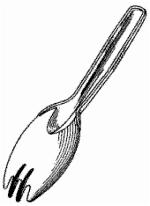
A 1998 design patent drawing for a spork, from U.S. Patent D388,664The fork. Such a simple, easy-to-use tool, considered indispensable but becoming obsolete as the fast-food industry changes the way we eat. But…where did the fork come from and how did this eating instrument come into common use? Off to Google-land I went.
The two-prong twig was perhaps the first fork. The word fork comes from the Latin furca, meaning "pitchfork." Some of the earliest known uses of forks with food occurred in Ancient Egypt where large forks were used as cooking utensils. The ancient Greeks used the fork as a serving utensil, and it is also mentioned in the Hebrew Bible, in the Book of I Samuel 2:13.
Most diners ate with their fingers and a knife, which they brought with them to the table. The personal table fork was most likely invented in the Eastern Roman, or Byzantine, Empire where they were in common use by the 4th century CE.
Europe did not adopt use of the fork until the 18th century. Its use was first described in English by Thomas Coryat in a volume of writings on his Italian travels (1611), but for many years it was viewed as an unmanly Italian affectation. The English ridiculed forks as being effeminate and unnecessary.
Some writers of the Roman Catholic Church expressly disapproved of its use (despite its above-mentioned use in the Bible), seeing it as "excessive delicacy": "God in his wisdom has provided man with natural forks – his fingers. Therefore it is an insult to Him to substitute artificial metallic forks for them when eating
Forks came to be adopted by the wealthy. They were prized possessions made of expensive materials intended to impress guests. In late 17th Century France, larger forks with four curved tines were developed. The additional tines made diners less likely to drop food, and the curved tines served as a scoop. Forks made before 1600 with as many as five tines still exist today.
The 20th century saw the emergence of the "spork", a utensil that is half-fork and half-spoon. The spork was trademarked in the 1969 but probably has been around for at least a century. With this new "fork-spoon", only one piece of cutlery is needed when eating (so long as no knife is required.)
Wikipedia lists and describes over 32 forks for different purposes., if you're interested.
I want to thank Chad Ward, author of An Edge in the Kitchen, for the additional information he provided.
Friday, June 1, 2012
Country Doings
Out here in the countryside, you never know what's going to happen. Not long after we moved our home onto the land, I looked up from my work in time to see several cows stroll past the window, headed for deep woods behind the house.
Knowing barbed wire fencing surrounded our acreage, I grew concerned as to how they would leave. I made a quick trip to the nearest neighbor, whose house I could barely see from my place. The elderly gent seemed unconcerned and not knowing anything else to do, I returned to my labors.
I never did learn where those cows went to or who they belonged to.
This morning, on my way to my little house, I caught sight of a BIG shaggy, dirty, white dog trotting toward me from the back forty. When I clapped and shouted, instead of turning and running, he just picked up speed as if eager to reach my side.
I called for backup and my husband came from the barn, curiosity aroused. Apparently the dog responds to a man's command because at the sound of his male shout, the dog turned tail and retraced his steps.
May never know who that dog belongs to or where it came from.
Now, I welcome unexpected visitors to my little place in the woods. People dropping by are few and far between. But a strange dog half my size that gave the appearance of being overly friendly isn't my idea of a welcome visitor.
Knowing barbed wire fencing surrounded our acreage, I grew concerned as to how they would leave. I made a quick trip to the nearest neighbor, whose house I could barely see from my place. The elderly gent seemed unconcerned and not knowing anything else to do, I returned to my labors.
I never did learn where those cows went to or who they belonged to.
This morning, on my way to my little house, I caught sight of a BIG shaggy, dirty, white dog trotting toward me from the back forty. When I clapped and shouted, instead of turning and running, he just picked up speed as if eager to reach my side.
I called for backup and my husband came from the barn, curiosity aroused. Apparently the dog responds to a man's command because at the sound of his male shout, the dog turned tail and retraced his steps.
May never know who that dog belongs to or where it came from.
Now, I welcome unexpected visitors to my little place in the woods. People dropping by are few and far between. But a strange dog half my size that gave the appearance of being overly friendly isn't my idea of a welcome visitor.
Monday, May 28, 2012
Building A Nest
Our resident bluebirds are busy hatching their second brood of the season. This particular pair chose a nesting box my husband hung on a pole at eye-level, thus making it convenient for us to keep an eye on progress.
We took turns peeking in earlier this spring. Through the entrance hole, we watched as four pale blue eggs morphed into baby birds. When a great-nephew came to visit a couple weekends ago, I took him to get a look. By then, the babies were already covered with blue feathers so we knew their launch into the world was imminent.
Once vacated, my husband cleaned out the nest's used materials so the parents would be encouraged to return. Sure enough, yesterday he announced there was another clutch of eggs snuggled in new nesting material.
Which got me to thinking. How much alike the birds are we humans? Are you someone who prefers to stay grounded in familiar surroundings? Maybe do a bit of rearranging or re-decorating when you feel the need for a change? Spiff up the place with new towels or pillows? Or do you get the itch every once in a while to put on your traveling shoes...try out new places to live...new situations to experience?
My husband and I have occupied our farmhouse for over thirty years. He's perfectly happy working with his farm equipment and barn full of tools. Maybe he'll consent to a trip to town once a week for a restaurant meal but has no desire to leave the place.
I, on the other hand, have always enjoyed traveling. I like going to new places, seeing different parts of the country, talking to strangers. Although the possibility never came up, I think I'd adjust to a change in location if the opportunity arose. Even so, as I age, my venturings don't seem to happen as frequently as in the past. And when I do hit the road for a bit, I'm always glad to get back to familiar surroundings.
Seems like unchanged surroundings are what I find myself most satisfied with these days. Oh, on occasion we've done things like slap a new coat of paint on the walls, or maybe invest in a new sofa when the original wore out. We've done a couple major remodeling jobs over the years to make life easier and more comfortable. But all in all, we've pretty much settled among our long-acquired familiar things.
Maybe the fact that we no longer have the demands of raising a family to contend with.has something to do with it...it's just the two of us now. And that's okay.
We took turns peeking in earlier this spring. Through the entrance hole, we watched as four pale blue eggs morphed into baby birds. When a great-nephew came to visit a couple weekends ago, I took him to get a look. By then, the babies were already covered with blue feathers so we knew their launch into the world was imminent.
Once vacated, my husband cleaned out the nest's used materials so the parents would be encouraged to return. Sure enough, yesterday he announced there was another clutch of eggs snuggled in new nesting material.
Which got me to thinking. How much alike the birds are we humans? Are you someone who prefers to stay grounded in familiar surroundings? Maybe do a bit of rearranging or re-decorating when you feel the need for a change? Spiff up the place with new towels or pillows? Or do you get the itch every once in a while to put on your traveling shoes...try out new places to live...new situations to experience?
My husband and I have occupied our farmhouse for over thirty years. He's perfectly happy working with his farm equipment and barn full of tools. Maybe he'll consent to a trip to town once a week for a restaurant meal but has no desire to leave the place.
I, on the other hand, have always enjoyed traveling. I like going to new places, seeing different parts of the country, talking to strangers. Although the possibility never came up, I think I'd adjust to a change in location if the opportunity arose. Even so, as I age, my venturings don't seem to happen as frequently as in the past. And when I do hit the road for a bit, I'm always glad to get back to familiar surroundings.
Seems like unchanged surroundings are what I find myself most satisfied with these days. Oh, on occasion we've done things like slap a new coat of paint on the walls, or maybe invest in a new sofa when the original wore out. We've done a couple major remodeling jobs over the years to make life easier and more comfortable. But all in all, we've pretty much settled among our long-acquired familiar things.
Maybe the fact that we no longer have the demands of raising a family to contend with.has something to do with it...it's just the two of us now. And that's okay.
Friday, May 25, 2012
Monkey No Hear, No Say, No See
Most everyone is familiar with the pictorial image of the three monkeys. One covers his ears, another covers his mouth and the third covers his eyes. This vivid proverb dates back to at least the 7th century and is part of the Vadjra cult that if we do not hear, talk or see evil, we ourselves shall be spared all evil.
In the 8th century A.D., a Buddhist monk from China introduced the three wise monkeys to Japan. I came across this grouping when on a visit to the Japanese Garden in Ft. Worth's Botanical Gardens. Still would like to get some for my garden.
Some contend it is nothing more than a reminder to not be so snoopy, so nosy, and so gossipy. Others say that it is a warning to stay away from places where immoral acts are taking place. Irregardless of the degree of warning these monkeys impart, in the present world we live in, how does one avoid seeing no evil. hearing no evil, or speaking no evil?
The Oxford American Dictionary--which I prefer to use because it retains many words no longer in common usage--defines 'evil' as both a noun and an adjective, with the adjective definitions being more explicit.
The shades of meaning for evil range from something very unpleasant or troublesome to something considered morally bad or wicked. Sometimes 'evil' merely denotes something harmful or intended to do harm as in the superstition of "an evil eye." That is to say, someone accused of having an evil eye is said to have a gaze or stare that could cause harm to others.
No matter how you personally interpret "see no evil, hear no evil, speak no evil," It's impossible to hear that phrase used without thinking of three wise, but very cute, monkeys.
In the 8th century A.D., a Buddhist monk from China introduced the three wise monkeys to Japan. I came across this grouping when on a visit to the Japanese Garden in Ft. Worth's Botanical Gardens. Still would like to get some for my garden.
Some contend it is nothing more than a reminder to not be so snoopy, so nosy, and so gossipy. Others say that it is a warning to stay away from places where immoral acts are taking place. Irregardless of the degree of warning these monkeys impart, in the present world we live in, how does one avoid seeing no evil. hearing no evil, or speaking no evil?
The Oxford American Dictionary--which I prefer to use because it retains many words no longer in common usage--defines 'evil' as both a noun and an adjective, with the adjective definitions being more explicit.
The shades of meaning for evil range from something very unpleasant or troublesome to something considered morally bad or wicked. Sometimes 'evil' merely denotes something harmful or intended to do harm as in the superstition of "an evil eye." That is to say, someone accused of having an evil eye is said to have a gaze or stare that could cause harm to others.
No matter how you personally interpret "see no evil, hear no evil, speak no evil," It's impossible to hear that phrase used without thinking of three wise, but very cute, monkeys.
Subscribe to:
Posts (Atom)